Measuring Medication Adherence Where It Matters Most
UMAS is the first psychometrically validated medication adherence scale developed specifically for Low- and Middle-Income Countries — capturing patient, medical, healthcare, and socioeconomic barriers in one instrument.
A Scale Built for Real-World Conditions
Most adherence instruments were developed in high-income settings. UMAS was built from the ground up for LMIC realities.
The UNPAD Medication Adherence Scale (UMAS) was developed and psychometrically validated by the Faculty of Pharmacy, Universitas Padjadjaran. It is the first medication adherence instrument specifically designed to reflect the barriers faced by patients in Low- and Middle-Income Countries.
UMAS captures four distinct domains — patient-related, medication-related, healthcare facility-related, and socioeconomic factors — collectively reflecting the multidimensional nature of medication adherence in LMIC contexts.
The instrument is freely available to researchers worldwide under an open-access model, with the commitment that resulting publications will be shared back to grow the collective evidence base.
Psychometrically Validated
Rigorous validity and reliability testing in a representative LMIC population.
Multidimensional Framework
4 evidence-based domains addressing barriers that single-domain scales miss.
Designed for LMICs
Built from the clinical and socioeconomic realities of low- and middle-income countries.
Open Access Model
Free for research use, with a commitment to cite and share resulting publications.
The Four UMAS Domains
Each domain targets a distinct cluster of adherence barriers, mapped through literature review and expert validation.
Internal barriers arising from the patient's cognition and behavior — forgetfulness, health beliefs, medication fatigue, intentional non-adherence, and behavioral patterns affecting daily use.
Barriers arising from the nature of the prescribed therapy — side effects, regimen complexity, treatment duration, and the patient's perceived effectiveness of their medication.
System-level barriers including service accessibility, wait times, quality of counseling, drug availability, and the patient-provider relationship that shape adherence behavior.
Structural barriers unique to LMICs — financial constraints, insurance status, family support, transportation, community norms, and cultural or religious influences on treatment adherence.
Intellectual Property
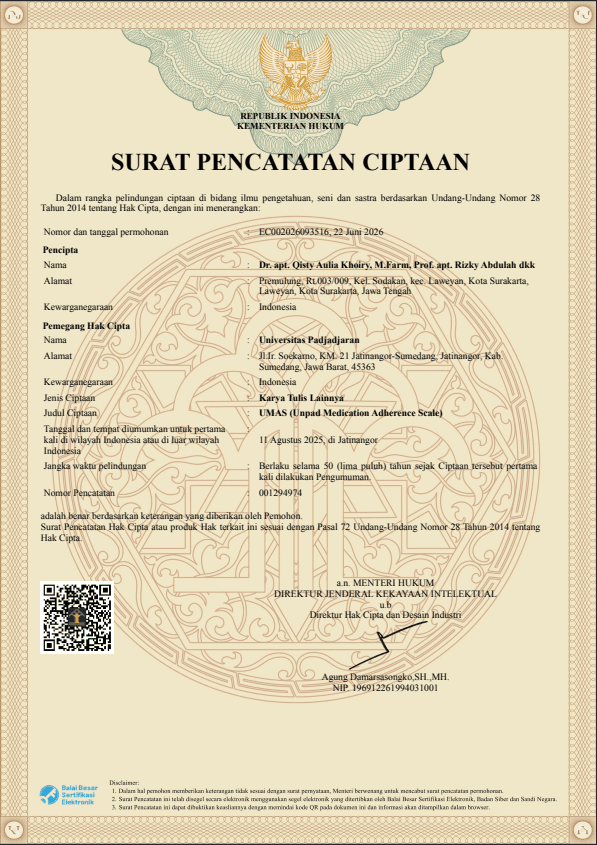
UMAS (Unpad Medication Adherence Scale) is officially registered as a protected work.
Registration Details
UMAS is officially registered with the Directorate General of Intellectual Property, Ministry of Law and Human Rights of Indonesia, providing legal protection under Indonesian copyright law.
Protection extends 50 years from first publication under Law No. 28 of 2014 on Copyright. Unauthorized commercial use is prohibited.
Despite protection, the UMAS instrument remains freely available for research, clinical practice, and education (open-access). Researchers must cite the original publication and share results with the UMAS community.